Multi-Rate Meters: How They Work, Benefits, Costs and Savings
Your electricity bill is one of those monthly costs that are easy to overlook until they become significant. For households and businesses that use a lot of power, even small changes to how and when you consume electricity can add up to significant savings over time. That is where multi rate meters come in.
Multi-rate meters charge different prices for electricity depending on the time of day you use it. While the concept may appear simple, the potential impact on your electricity bill can be significant. By shifting your high-energy activities, like running the dishwasher or charging an electric vehicle, to off-peak hours, you can pay a lot less for the same amount of electricity.
This guide covers Time-of-Use Meters: how they work, who they are for, and how to use them. By the end, you will have a clear picture of whether switching makes financial sense for your home or business.
Table of Contents
What Are Multi-Rate Meters?
A multi rate meter (also known as a time-of-use meter) is a type of electricity meter that measures your electricity usage at various rates based on the time of day. Different from a standard meter, which always charges the same rate no matter the time of your electricity usage, multi rate meters separate your usage into different pricing periods.
The most well-known example in the UK is the Economy 7 meter, which offers cheaper electricity for seven hours overnight. Economy 10 is another popular option, offering ten hours of reduced-rate electricity spread across the day and night.
Multi-rate pricing is based on the basic operation of the electric grid. The need for electricity varies during the day, with the highest demand in the morning and evenings when most people are home and busy. By incentivising consumers to shift their usage to quieter periods, energy suppliers can reduce strain on the grid and pass some of those savings on to customers.
How Do Multi Rate Meters Work?
Multi-rate meters are programmed to record electricity usage in separate registers, each corresponding to a different pricing period. Your energy supplier determines when each rate applies, and these windows are set based on regional grid demand patterns.
For example, with an Economy 7 meter, the peak rate applies during daytime and evening hours when demand is high.
- Peak rate: Applied during daytime and evening hours when demand is high.
- Off-peak rate: Applied for seven hours overnight (typically between midnight and 7 a.m.), when the cost of electricity is significantly lower.
The supplier will check the registers and charge you after your billing cycle. So, if your major usage of electricity is through off-peak hours, you will have a lower sum to pay compared to a person on a plain single-rate tariff who uses the same total amount of energy.
How to Read a Multi Rate Meter
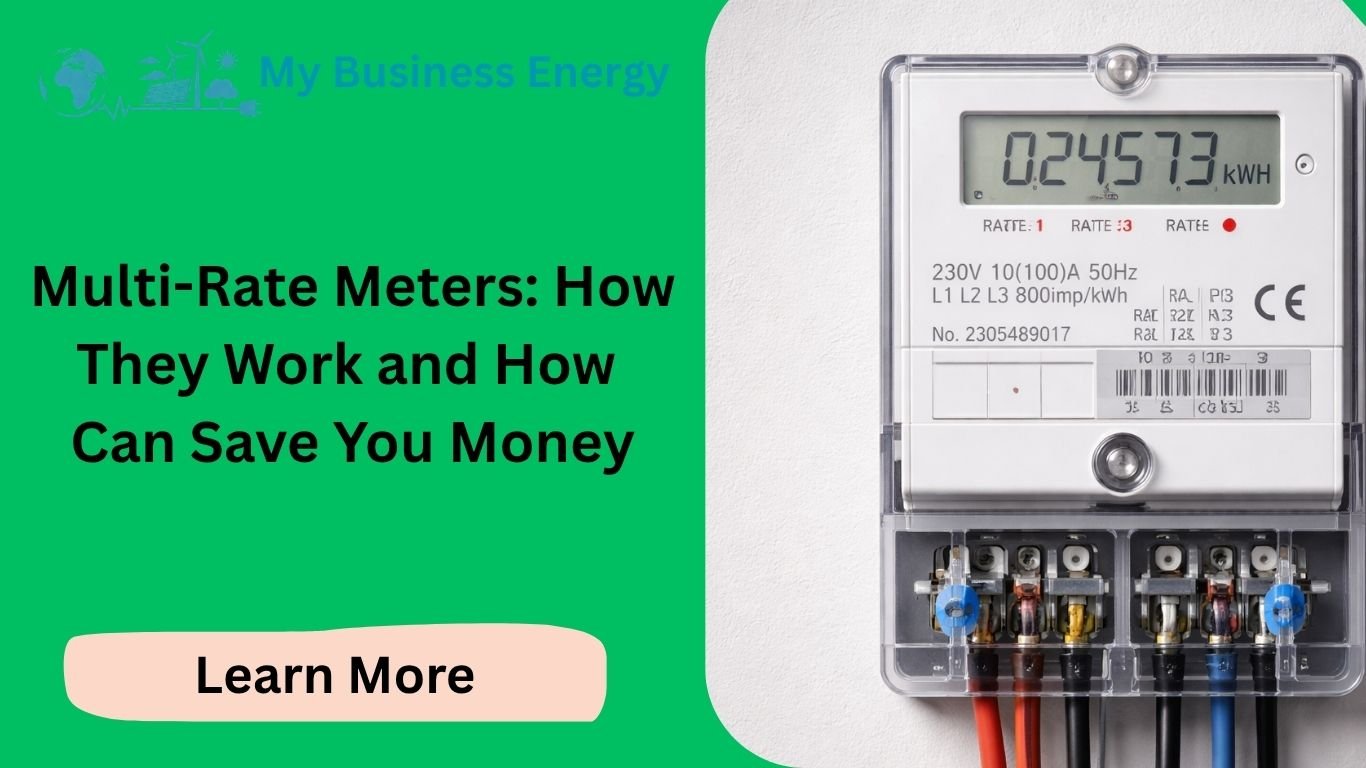
Reading a multi-rate meter is slightly more involved than reading a standard meter because you’re dealing with two or more registers.
- Locate the display: Usually, a meter will cycle through displays one after the other automatically, or you might have to press a button to switch between the registers.
- Identify each register by looking for labels such as “Rate 1,” “Rate 2,” “Low,” or “Normal.” Rate 1 or “Normal” is generally the peak rate; Rate 2 or “Low” is the off-peak rate.
- Record both readings: Note the numbers shown on each register (ignoring any digits after the decimal point).
- Submit your readings: Please submit your readings by providing both figures to your energy supplier to ensure accurate billing.
If you have a smart meter, readings are submitted automatically—so you won’t need to do the task manually.
Benefits of Multi-Rate Meters
There are several compelling reasons to consider switching:
- Lower electricity costs: Off-peak prices may be much lower, even 50% cheaper than regular daytime prices in some cases.
- Supports storage heating: If you’re using electric storage heaters, these can be set to charge at night when off-peak cheap electricity is available and to give out heat all day long.
- Multi-rate tariffs help distribute demand evenly, resulting in a consistent and environmentally friendly electricity grid.
- Compatible with renewable energy: And that is because the amount of renewable energy (like wind) that is being produced overnight is increasing, so off-peak rates are beginning to be more in line with green electricity.
Common Problems with Multi-Rate Meters
Like any technology, multi-rate meters are not without their challenges.
- Incorrect meter readings: can lead to billing errors if you misread or submit the registers incorrectly.
- Off-peak timing changes: Suppliers can change off-peak periods, which might alienate your regular patterns and lead to increased energy costs if you are unable to adjust your usage accordingly.
- Higher peak rates: If you are unable to use a considerable amount of energy during off-peak hours because of your lifestyle, then you might have to bear higher costs.
- Compatibility issues: Older types of meters may not be suitable for the new tariffs or smart home systems.
- Limited tariff options: Not all suppliers offer competitive multi-rate tariffs in all regions.
Different Types of Time-of-Use Meters
Not all multi rate meters are the same. Here are the main types currently available:
- Economy 7
Economy 7 is a type of electricity plan in the UK that provides more affordable electricity for 7 hours of off-peak time (usually at night) and regular rates during the day. It is perfect for those who operate appliances such as storage heaters or electric boilers mostly at night to lower their electricity bills.
- Economy 10
Economy 10 is an electricity tariff available in the UK that provides 10 hours of cheaper electricity, which are divided into night, afternoon, and evening hours. It is mainly intended for houses with storage heaters or other types of flexible electricity usage, allowing customers to save money by using electricity during off-peak periods rather than standard daytime rates.
- Smart meters
Smart meters are electronic devices for recording electricity usage automatically. They not only keep a constant eye on your power usage but also deliver the data to the energy company. Smart meters give instant feedback on consumption, make accurate invoicing, guide you in effective energy management, and ultimately help in reducing costs and preventing unexpected charges.
- Prepayment multi-rate meters:
Multi-rate prepayment meters are devices that measure energy consumption and require you to pay for electricity before use. Besides, they can switch to different rates at various times of the day. With the help of these meters, users can save money by consuming energy during the less expensive off-peak periods, and they also find it easier to manage their budget as they are empowered to decide the amount they want to spend.
Multi Rate Meters vs. Single Rate Meters
Here is a simple comparison table for Multi-Rate Meters vs. Single-Rate Meters:
Feature | Single-Rate Meter | Multi-Rate Meter |
| Pricing | Flat rate all day | Varies by time of day |
Billing simplicity | High | Moderate |
Savings potential | Low | High (if usage shifted) |
Best for | Low/average usage | High usage or flexible schedules |
How to Check if You Have a Multi-Rate Meter
Not sure what type of meter you currently have? Here’s how to find out:
- Check your electricity bill: Look for two separate unit rates or references to “Economy 7” or “Economy 10”.
- Inspect your meter: Time-of-Use Meters display two or more readings, whereas single-rate meters show just one.
- Contact your supplier: Your energy supplier can confirm your meter type and current tariff.
How Can Multi-Rate Meters Help Reduce Energy Bills?
Yes, but only under the right conditions. Research from Ofgem (the Office of Gas and Electricity Markets) and various energy consultancies suggests that households with storage heating or EVs (electric vehicles) can save hundreds of pounds per year by switching to a time-of-use tariff. However, households that primarily use electricity during the day may end up paying more, since peak rates on multi-rate tariffs can exceed standard single-rate prices.
The key question to ask yourself: Can I move at least 40–50% of my electricity usage to off-peak hours? If the answer is yes, multi rate metering is likely to deliver genuine savings.
Best Times to Use Electricity with Multi-Rate Meters
The exact off-peak windows depend on your tariff and supplier, but as a general guide:
- Overnight (midnight to 7 a.m.): The primary off-peak window for most Economy 7 customers
- Early morning and early afternoon: Additional windows available on Economy 10 tariffs
- Weekends: Some tariffs offer reduced rates on weekends when grid demand is lower.
To maximise savings, schedule energy-intensive tasks—laundry, dishwashing, EV charging, and immersion heater usage—in these windows whenever possible.
Who Should Use Multi-Rate Meters?
Time-of-Use Meters work best for people who have the flexibility, or the technology, to shift their electricity usage to off-peak hours. Ideal candidates include:
- Electric vehicle owners who can charge overnight
- Households with storage heaters that can be programmed to run at night
- Families with smart appliances (dishwashers, washing machines) that can be scheduled
- Night-shift workers who are naturally more active during off-peak hours
- Businesses with overnight operations or flexible energy schedules
On the other hand, if your lifestyle keeps you home and consumes electricity throughout the day with little ability to shift usage, a multi-rate meter may actually cost you more due to higher peak rates.
Multi Rate Meters and Ofgem Regulations
Ofgem, the UK’s energy regulator, oversees the standards and consumer protections that apply to multi rate metering. Key regulatory points include the following:
- Suppliers must clearly communicate the peak and off-peak windows in your tariff documentation.
- Smart meter installations are subject to Ofgem’s smart metering framework, which governs data privacy, interoperability, and consumer rights.
- If you are changing tariffs or the supplier, you have a right to a straightforward explanation showing how your new prices stand against your existing deal.
- Ofgem has set a price cap on default tariffs; however, time-of-use tariffs could be outside the cap based on their design, so you should always read the terms closely.
Things to Consider Before Switching
Before making the switch, weigh up the following:
- Your current usage patterns: Review past bills to understand when you use the most electricity.
- Your home setup: Do you have storage heaters, an EV, or smart appliances that can be scheduled?
- Peak rate comparison: Check whether the peak rate on a multi-rate tariff is higher than your current single-rate price.
- Standing charges: Some multi-rate tariffs carry higher daily standing charges, which can offset savings.
- Meter installation costs: In some cases, installing a new meter may come with upfront costs—confirm this with your supplier.
Are Time-of-Use Meters Suitable for Businesses?
Yes, and often very much so. Businesses that run their activities late in the evening or early in the morning – such as warehouses, manufacturing plants, restaurants, and hotels – are excellent candidates for time-of-use pricing. Those who consume a large amount of energy stand to benefit more from this change. That’s because, even if the per-unit cost becomes reduced only slightly, when you multiply that by the number of units consumed on an annual basis, the savings become very significant at scale.
It is possible that small businesses that operate mainly during regular working hours (9 to 5) may not gain significantly from such a change, as their peak usage hours coincide almost exactly with the peak prices’ timings. In such cases, these businesses applying other energy efficiency measures, such as LED lighting (energy-efficient light bulbs), better insulation (materials that reduce heat loss), and smart scheduling of HVAC systems (heating, ventilation, and air conditioning), will get a better return.
How to Switch to a Multi-Rate Meter
Switching is usually a straightforward process:
- Contact your current energy supplier to ask whether they offer time-of-use tariffs.
- Compare tariffs using a comparison site to find the best available deal
- Request a meter upgrade if your current meter doesn’t support multi-rate billing.
- Schedule installation: A qualified engineer will install your new meter, usually at no charge (though the cost varies by supplier).
- Program your appliances: Set timers on your dishwasher, washing machine, and other high-draw devices to run during off-peak hours.
Tips to Save More Money with Multi-Rate Meters
Getting the most out of your multi rate meter requires a bit of planning, but the payoff is worth it:
- Use appliance timers: Program your washing machine, dishwasher, and tumble dryer to operate in the off-peak periods.
- Charge your electric vehicle overnight: Before going to bed, you just have to plug your car into the charger, and then in the morning you will find it completely charged at a much lower price.
- Invest in a smart thermostat: You can set up your heating to turn on and off automatically and thus enjoy the cheaper electricity prices during the night.
- Install a hot water timer: Set your immersion heater to operate when there is less load on the grid and keep the water warm throughout the day.
- Monitor your usage: Use your smart meter’s in-home display (IHD) or energy app to monitor consumption patterns. Energy pricing evolves, and there may be better deals available as the market changes.
Final Thoughts on Multi-Rate Meters
Multi-rate meters will not save everyone money, but for the right household or business, they can make a meaningful difference. The key is being honest about your electricity habits. If you can genuinely shift a substantial portion of your usage to off-peak hours, the savings can be significant, especially for EV (electric vehicle) owners, storage heater users, and high-consumption households.
Start by reviewing your current usage patterns and speaking with your energy supplier about available time-of-use tariffs. The more you know, the greater your chances of making a favourable switch.
If you want to learn more about Business Energy Guide please visit our website.
FAQS
Here are answers to common questions about who can use them, how they work with solar panels, and how they affect electricity and gas bills.
Q1: Can I use a multi-rate meter in rental properties?
Yes, but you may need landlord approval, and the tenant will need to agree to shift usage to off-peak times to save money.
Q2: Do all energy providers offer multi-rate meters?
Not all providers offer them, so you should check with your local supplier to see if multi-rate options are available in your area.
Q3: Do multi-rate meters work with solar panels?
Yes, they can complement solar energy systems, especially if you use stored solar power during peak times or sell excess energy back to the grid.
Q4: How do I know if a multi-rate meter is right for me?
Consider your lifestyle, daily routines, and energy usage patterns. If you can run high-energy appliances during off-peak hours, it’s likely a beneficial fit.
Q5: Do multi-rate meters affect gas bills?
No, multi-rate meters are specific to electricity. Gas usage is usually charged at a single rate.
Q6: Can businesses use multi-rate meters too?
Yes, commercial properties often benefit even more, as shifting high-energy operations to off-peak hours can lead to significant savings, which is particularly advantageous for businesses that operate during non-peak times.