Business Energy Tariffs Explained for UK Businesses in 2026
Choosing the right business energy tariff is important for every UK business because energy costs can directly affect monthly expenses and overall profit. Whether you run a shop, restaurant, office, salon, warehouse, or small company, your tariff decides how much you pay for the electricity and gas your business uses. Many business owners only look for the cheapest rate, but a good tariff is not only about a low unit price. It also includes standing charges, contract length, renewal terms, and possible exit fees.
Business energy tariffs can be more complex than domestic energy deals because they are usually based on fixed contracts and specific business usage. If a business does not understand its tariff properly, it may end up paying higher rates or missing a better deal at renewal time. This guide explains business energy tariffs in simple words, including fixed and variable tariffs, unit rates, standing charges, and the key points to check before choosing a new business energy deal.
Table of Contents
What Is an Energy Tariff?
An energy tariff is the pricing plan that decides how much a business pays for its gas or electricity. It includes the cost of each unit of energy used, usually measured in kilowatt-hours, and a daily standing charge for keeping the business connected to the energy supply. In simple words, your tariff is the structure of your energy bill.
For businesses, energy tariffs are usually based on contracts. This means the business agrees to certain prices and terms for a specific period, such as 12 months, 24 months, or longer. Different tariffs can have different unit rates, standing charges, contract lengths, payment terms, and renewal conditions, so it is important to understand the full tariff before choosing a deal.
Business Energy Tariffs vs Domestic Energy Tariffs
Business energy tariffs are different from domestic energy tariffs because they are usually designed around commercial usage, contract terms, and business needs. A home energy tariff is mainly created for household electricity and gas use, while a business energy tariff is based on how much energy a company uses, where the business is located, the type of meter installed, and the length of the contract.
Another key difference is that business energy contracts are often more fixed and formal. Businesses normally agree to a contract for a specific period, such as 12 months or longer. If the contract end date is missed, the business may move onto higher rates or less suitable terms. This is why business owners need to check their tariff carefully, compare prices before renewal, and understand both the unit rate and standing charge before choosing a deal.
Main Types of Business Energy Tariffs
Business energy tariffs are not the same for every company. Different businesses have different energy needs, so suppliers offer different types of tariffs based on usage, contract length, risk level, and pricing structure. A small office may need a simple fixed tariff, while a restaurant, warehouse, factory, or multi-site business may need a more carefully planned energy contract. Understanding the main types of business energy tariffs helps business owners choose a deal that matches their budget and daily operations.
Fixed Business Energy Tariff
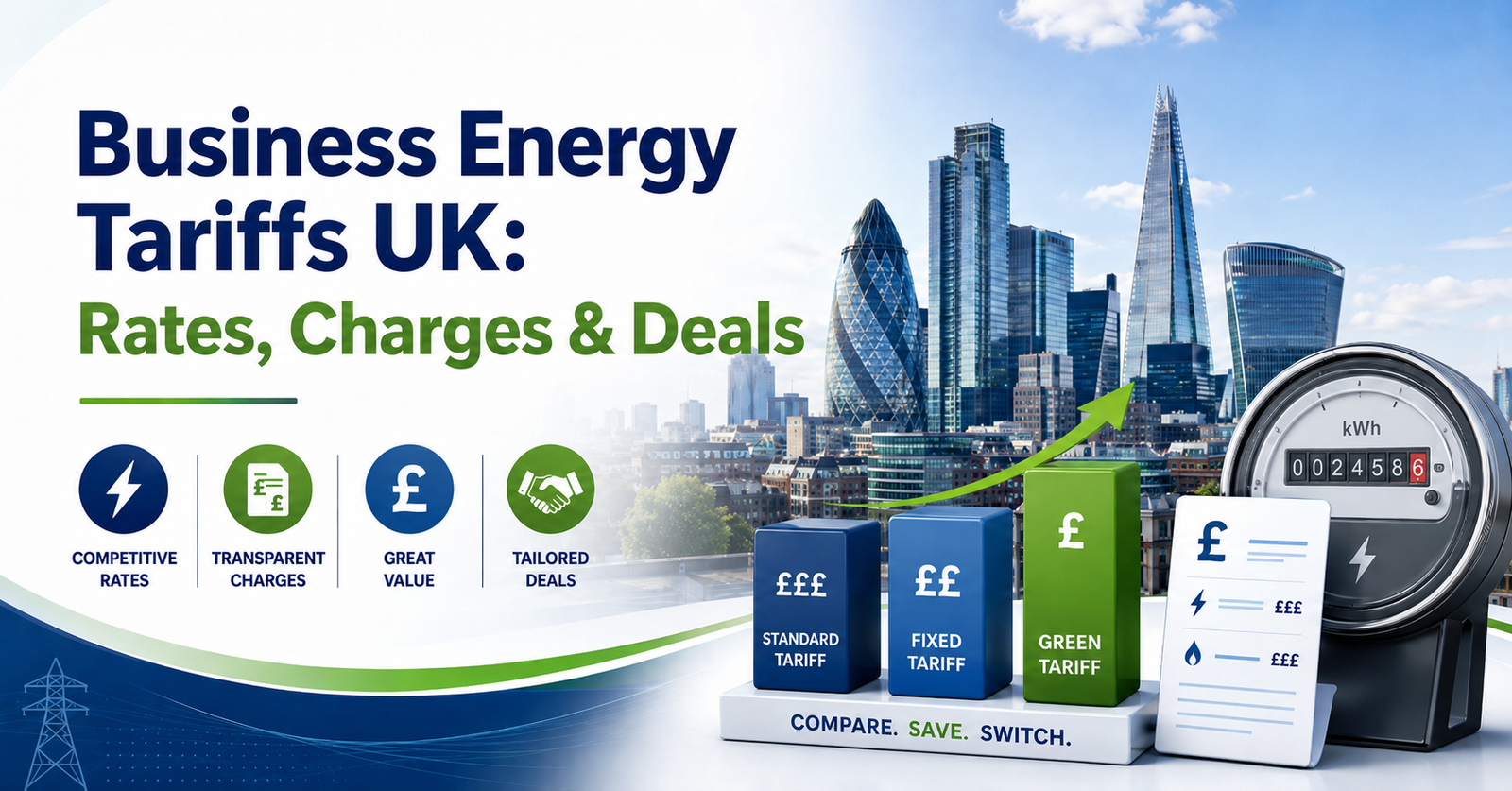
A fixed business energy tariff keeps your unit rate the same for a set contract period, such as 12 or 24 months. It helps businesses plan their bills more easily because the price per unit does not usually change during the contract. This tariff is useful for businesses that want stable and predictable energy costs.
Variable Business Energy Tariff
A variable business energy tariff can change depending on market prices and supplier terms. This means your energy bill may go up or down over time. It can offer flexibility, but it may not be ideal for businesses that need fixed monthly budgeting.
Deemed Energy Rates
Deemed rates usually apply when a business moves into a new premises and starts using energy without agreeing to a formal contract. These rates can be higher than normal contract rates, so businesses should arrange a proper energy deal as soon as possible.
Out-of-Contract Rates
Out-of-contract rates apply when a business energy contract ends and no new deal is arranged. These rates are often more expensive than agreed contract rates. Businesses should track their contract end date to avoid moving onto higher prices.
Green Business Energy Tariff
A green business energy tariff is designed for businesses that want to support renewable energy. It may include electricity from renewable sources such as wind, solar, or hydro. Businesses should still compare the unit rate, standing charge, and contract terms before choosing a green tariff.
Unit Rate Explained
The unit rate is the price a business pays for each unit of gas or electricity it uses. Energy usage is usually measured in kilowatt-hours, also called kWh. For example, if your business uses more electricity for lighting, computers, ovens, machinery, heating, or cooling, your total bill will increase based on the unit rate agreed in your tariff.
Unit rate is one of the most important parts of a business energy tariff because it directly affects the total cost of energy usage. Businesses with high energy use, such as restaurants, warehouses, factories, salons, and retail shops, should pay close attention to the unit rate before choosing a deal. Even a small difference in the unit rate can make a big difference in yearly energy costs when the business uses a large amount of electricity or gas.
Standing Charge Explained
A standing charge is a fixed daily amount that a business pays for having gas or electricity supplied to its premises. This charge is added to the energy bill even if the business uses little or no energy on a particular day. It helps cover the cost of maintaining the supply connection, meter, and energy network services.
Standing charge is important because it can affect the total bill, especially for small or low-usage businesses. For example, a small office or seasonal shop may use less energy, but it still has to pay the daily standing charge. This is why businesses should compare both the unit rate and the standing charge before choosing a tariff. A tariff with a low unit rate but a high standing charge may not always be the cheapest option.
What Affects Business Energy Tariff Prices?
Business energy tariff prices can change from one business to another because every business has different energy needs. Suppliers usually look at factors such as business location, annual energy usage, meter type, contract length, and the type of business before offering a price. For example, a restaurant, factory, salon, office, or retail shop may all receive different rates because their energy use is not the same.
Location can also affect prices because energy network costs may vary by region. A business with high electricity or gas usage may be offered different rates compared to a small low-usage business. Meter type is another important factor, especially if the business has a smart meter, multi-rate meter, or half-hourly meter. Contract length also matters because a longer contract may provide price stability, while a shorter contract may give more flexibility. This is why businesses should compare tariffs based on their own usage instead of choosing a deal only because it looks cheap.
Fixed vs Variable Business Energy Tariff: Which Is Better?
A fixed business energy tariff is usually better for businesses that want stable and predictable energy costs. In a fixed tariff, the unit rate is agreed for a set contract period, so it becomes easier to plan monthly and yearly expenses. This can be useful for shops, restaurants, offices, salons, and other businesses that want to avoid sudden price changes.
A variable business energy tariff may suit businesses that need more flexibility or do not want to commit to a long contract. However, the price can change, which means bills may increase or decrease over time. The better option depends on the business’s energy usage, budget, contract needs, and risk level. Before choosing, businesses should compare the unit rate, standing charge, contract length, exit fees, and renewal terms.
How to Compare Business Energy Tariffs Properly
Comparing business energy tariffs is not only about finding the lowest unit rate. A business should compare the full deal, including the unit rate, standing charge, contract length, payment terms, exit fees, and renewal conditions. Sometimes a tariff may look cheap because the unit rate is low, but the standing charge or contract terms may make the total cost higher.
The first step is to check your current energy bill. Your bill usually shows your current supplier, unit rate, standing charge, annual usage, meter details, and contract end date. These details help you compare new tariffs more accurately because suppliers need your actual business usage to provide a better estimate.
Businesses should also compare the total yearly cost instead of only checking one part of the tariff. For example, a high-usage business should focus strongly on the unit rate because even a small difference can affect annual costs. A low-usage business should also check the standing charge carefully because it pays this daily charge even when energy use is low.
Before choosing a tariff, it is also important to check the contract terms. Look at the contract length, renewal date, exit fee, payment method, and supplier support. A good business energy deal should match your usage, budget, and long-term needs, not just look attractive at first glance.
Common Mistakes Businesses Make When Choosing Energy Tariffs
Many businesses make the mistake of choosing an energy tariff only by looking at the lowest unit rate. A low unit rate can look attractive, but it does not always mean the total bill will be cheaper. If the standing charge is high or the contract terms are not suitable, the business may still end up paying more.
Another common mistake is ignoring the contract end date. When a business energy contract ends and no new deal is arranged, the business may move onto out-of-contract rates. These rates can be more expensive than agreed contract rates, so businesses should track their renewal date and compare new deals before the current contract finishes.
Some businesses also forget to check their annual energy usage before comparing tariffs. Without knowing how much gas or electricity the business uses, it is difficult to choose the right tariff. A high-usage business may need a different deal compared to a small office or low-usage shop.
Businesses should also avoid signing a long contract without understanding the full terms. A longer contract can provide price stability, but it may also reduce flexibility if market prices change or the business needs change. Before choosing any tariff, businesses should review the unit rate, standing charge, contract length, exit fees, renewal terms, and supplier support.
Practical Examples
Understanding business energy tariffs becomes easier when we look at real business situations. Different businesses use energy in different ways, so the best tariff for one business may not be the best option for another. A small office, a restaurant, and a retail shop can all have different energy needs, even if they are in the same city.
Example 1: Small Retail Shop
A small retail shop may use electricity for lights, card machines, tills, small appliances, and heating or cooling. If the shop does not use a very high amount of energy, the standing charge becomes important because it is paid every day. For this type of business, choosing a tariff with a fair unit rate and a reasonable standing charge can help keep bills under control.
Example 2: Restaurant or Café
A restaurant or café usually uses more gas and electricity than a small office or shop. It may need energy for cooking equipment, ovens, fridges, freezers, lighting, heating, cooling, and hot water. For this type of business, the unit rate is very important because high energy usage means even a small price difference can affect the yearly bill.
Example 3: Office-Based Business
An office-based business may mainly use electricity during working hours for computers, printers, lighting, internet equipment, heating, and air conditioning. A fixed tariff may be useful for an office because it helps with monthly budget planning. However, the business should still compare the standing charge, contract length, and renewal terms before choosing a deal.
Example 4: Warehouse or Factory
A warehouse or factory may use large amounts of electricity for machinery, lighting, heating, cooling, and operational equipment. These businesses should compare tariffs carefully because their energy usage can be much higher than small businesses. A small difference in unit rate can create a big difference in total annual cost.
When Should a Business Switch Energy Tariff?
A business should consider switching its energy tariff when the current contract is close to ending, when energy bills are becoming too high, or when the business finds a better deal with another supplier. Waiting until the last minute can be risky because the business may move onto higher out-of-contract rates if a new deal is not arranged in time. This is why business owners should keep track of their contract end date and start comparing tariffs before the renewal period.
A business may also need to switch tariff if its energy usage has changed. For example, if a shop expands, a restaurant adds new equipment, or an office increases working hours, the old tariff may no longer be suitable. Businesses should also review their tariff when moving to new premises, facing poor supplier service, or looking for a green energy option. Switching at the right time can help a business get better control over energy costs and avoid paying more than necessary.
What Information Do You Need Before Comparing?
Before comparing business energy tariffs, it is important to keep your latest energy bill with you. The bill usually contains the key details needed to get an accurate comparison, such as your current supplier, business address, meter number, current unit rate, standing charge, contract end date, and annual energy usage. Without this information, it can be difficult to compare tariffs properly because every business has different energy needs.
Businesses should also know whether they need electricity, gas, or both. If your business has recently moved premises, expanded operations, added new equipment, or changed working hours, your energy usage may also change. Sharing the correct details helps suppliers or energy consultants find a tariff that matches your business instead of giving a general estimate. The more accurate your information is, the easier it becomes to compare prices, avoid unsuitable deals, and choose a better business energy tariff.
Conclusion
Choosing the right business energy tariff is not only about finding the lowest unit rate. A good tariff should match your business usage, budget, contract length, and long-term needs. Businesses should always compare the unit rate, standing charge, renewal terms, exit fees, and supplier conditions before making a final decision.
By understanding how fixed tariffs, variable tariffs, deemed rates, out-of-contract rates, unit rates, and standing charges work, business owners can make better energy decisions. Comparing tariffs at the right time can help avoid expensive rates, improve cost control, and make business energy bills easier to manage.
For more detailed guides and the latest updates, explore our Energy Guide.