Business Energy Tariffs UK: Types, Costs & How to Choose the Best Deal
Choosing the right business energy tariff can help UK businesses reduce energy costs and improve budgeting. A business energy tariff determines how much you pay for electricity or gas through unit rates, standing charges, and contract terms.
This guide explains the main tariff types and how to compare them to find the best deal for your business.
What Is a Business Energy Tariff?
A business energy tariff is the pricing plan that determines how much your business pays for electricity or gas. It includes the unit rate, standing charge, contract length, and other terms that affect your overall energy costs. Choosing the right tariff can help reduce business expenses and make monthly budgeting more predictable.
According to Ofgem, every UK business needs an appropriate energy contract for the electricity or gas it uses. The price you pay depends on several factors, including your energy consumption, meter type, contract type, supplier, and business location. Understanding these factors makes it easier to compare Energy contract, avoid unexpected costs, and choose the most suitable deal for your business.
What Are the Main Types of Business Energy Tariffs?
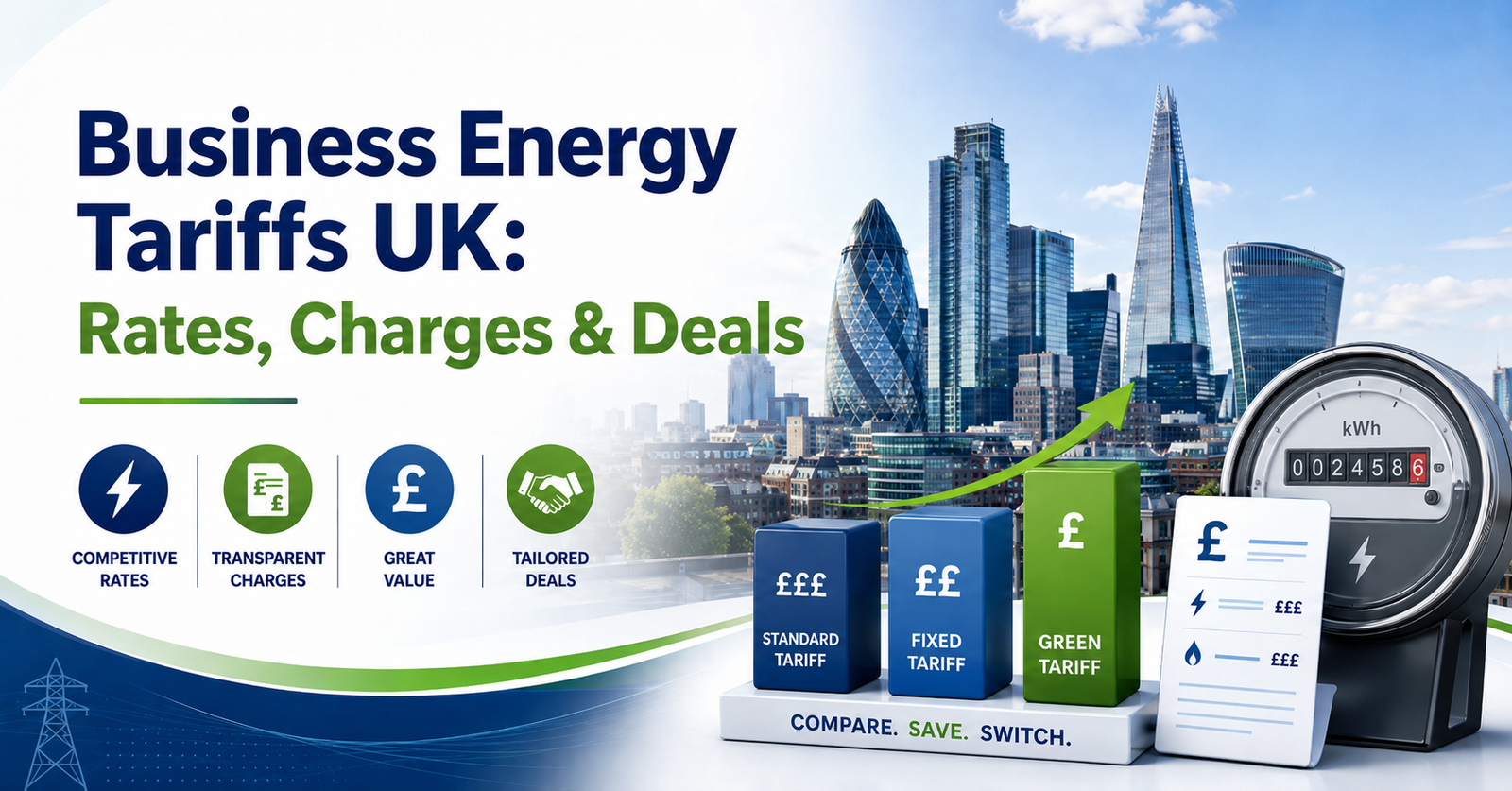
Business energy tariffs are available in different types to suit different business needs. The right tariff depends on your energy usage, budget, and contract preferences. Understanding these options makes it easier to compare suppliers and choose the best deal for your business. Business contracts commonly include fixed, variable, deemed, and out-of-contract options, each with different pricing and terms.
The table below highlights the main types of business energy tariffs and their key benefits. Comparing these options can help you choose a tariff that best matches your business needs and budget.
| Tariff Type | Best For | Price Stability | Contract Length | Risk Level |
| Fixed Tariff | Businesses with predictable budgets | High | 1–3 years | Low |
| Variable Tariff | Businesses that prefer flexibility | Low | Rolling or short-term | Medium to High |
| Green Tariff | Businesses focused on sustainability | Medium | 1–3 years | Low |
| Deemed Tariff | New business premises without a contract | Low | No fixed term | High |
| Out-of-Contract Tariff | Businesses that missed contract renewal | Very Low | No fixed term | High |
1. Fixed Business Energy Tariff
A fixed business energy tariff keeps your unit rate the same for the length of your contract, typically between 12 and 36 months. This helps businesses manage their energy costs with greater confidence, as market price changes do not affect the agreed unit rate during the contract.
It is a popular choice for businesses that want stable and predictable energy bills. Keep in mind that while the unit rate stays fixed, your total bill will still depend on how much energy your business uses.
2. Variable Business Energy Tariff
A variable business energy tariff has unit rates that can increase or decrease during the contract, depending on market conditions and your supplier’s pricing. This means your energy bills may change over time, making costs less predictable than a fixed tariff. While a variable tariff offers greater flexibility and allows businesses to benefit if energy prices fall, it may not be the best choice for businesses that need stable monthly budgeting.
3. Deemed Energy Rates
Deemed energy rates apply when a business starts using electricity or gas without agreeing to a formal energy contract, such as when moving into new premises. These default rates are usually higher than negotiated business tariffs, so it’s best to arrange a new energy contract as soon as possible to avoid paying unnecessary costs.
Ofgem also notes that businesses may be placed on a deemed contract if an existing agreement ends without clear post-expiry arrangements.
4. Out-of-Contract Rates
Out-of-contract rates apply when your business energy contract ends and you do not renew or switch to a new deal. These default rates are usually higher than standard contract prices, which can significantly increase your energy bills.
To avoid paying more than necessary, review your contract end date in advance and arrange a new business energy tariff before your current agreement expires. Ofgem also distinguishes out-of-contract rates from deemed rates, although both are typically more expensive than negotiated contracts.
5. Green Business Energy Tariff
A green energy tariff is designed for businesses that want to reduce their environmental impact by supporting renewable energy sources such as wind, solar, and hydro power. While these tariffs can help businesses meet sustainability goals, it’s still important to compare the unit rate, standing charge, contract length, and overall terms to ensure you’re getting the best value.
Many UK suppliers offer green tariffs, but the level of renewable energy backing can vary, so always review the tariff details before signing a contract.
What’s the Difference Between Business and Domestic Energy Tariffs?
Business energy tariffs are different from domestic energy tariffs because they are usually designed around commercial usage, contract terms, and business needs. A home energy tariff is mainly created for household electricity and gas use, while a business energy tariff is based on how much energy a company uses, where the business is located, the type of meter installed, and the length of the contract.
Another key difference is that business energy contracts are often more fixed and formal. Businesses normally agree to a contract for a specific period, such as 12 months or longer. If the contract end date is missed, the business may move onto higher rates or less suitable terms. This is why business owners need to check their tariff carefully, compare prices before renewal, and understand both the unit rate and standing charge before choosing a deal.
| Feature | Business Energy Tariffs | Domestic Energy Tariffs |
| Purpose | Designed for businesses and commercial premises | Designed for homes and residential properties |
| Pricing | Based on business usage, contract terms, and supplier quotes | Often influenced by the domestic market and regulated protections |
| Contract Length | Usually 1–5 years | Commonly 12–24 months or variable tariffs |
| Best For | Offices, shops, restaurants, warehouses, and other businesses | Households and residential properties |
Unit Rate Explained
A unit rate is the amount your business pays for each unit of electricity or gas it uses, measured in kilowatt-hours (kWh). The more energy your business consumes, the higher your bill will be based on the agreed unit rate.
Businesses with high energy usage, such as restaurants, factories, warehouses, and retail stores, should compare unit rates carefully, as even a small difference in price per kWh can have a significant impact on annual energy costs. Alongside the standing charge, the unit rate is one of the main costs included in a business energy contract.
Standing Charge Explained
A standing charge is a fixed daily fee that your business pays to keep its gas or electricity supply connected, even if no energy is used that day. This charge helps cover the cost of maintaining the energy network, meters, and other essential supply services. Along with the unit rate, it forms a key part of your business energy bill.
When comparing business energy tariffs, don’t focus only on the unit rate. A tariff with a low unit rate but a high standing charge may still cost more overall, especially for businesses with low energy usage. That’s why it’s important to compare the total cost of a tariff before choosing a new energy contract. Ofgem explains that standing charges cover fixed costs related to supplying energy and apply regardless of daily energy consumption.
What Affects Business Energy Tariff Price?
Business energy tariff prices vary because every business has different energy requirements. Suppliers calculate prices based on factors such as your annual energy usage, business location, meter type, contract length, and the type of business you operate. For example, a restaurant, warehouse, office, or retail shop may receive different quotes because their energy consumption and operating patterns are not the same.
Other factors, such as wholesale energy prices, network costs, and government levies, can also influence the rates offered by suppliers. That’s why businesses should compare tariffs based on their actual energy usage and overall contract value rather than choosing a deal based only on the lowest advertised unit rate.
Fixed vs Variable Business Energy Tariff: Which Is Better?
A fixed business energy tariff is usually better for businesses that want stable and predictable energy costs. In a fixed tariff, the unit rate is agreed for a set contract period, so it becomes easier to plan monthly and yearly expenses. This can be useful for shops, restaurants, offices, salons, and other businesses that want to avoid sudden price changes.
A variable commercial energy tariff may suit businesses that need more flexibility or do not want to commit to a long contract. However, the price can change, which means bills may increase or decrease over time. The better option depends on the business’s energy usage, budget, contract needs, and risk level. Before choosing, businesses should compare the unit rate, standing charge, contract length, exit fees, and renewal terms.
How to Compare Commercial energy tariff Properly
Comparing business energy tariffs isn’t just about finding the lowest price. Looking at the full contract helps you choose a tariff that offers better value and avoids unexpected costs over time. Energy comparison experts recommend evaluating the total annual cost rather than focusing only on the unit rate.
- Compare the unit rate to understand the cost per kWh.
- Check the standing charge as it affects your daily costs.
- Review the contract length to ensure it suits your business.
- Look for exit fees before signing a fixed-term contract.
- Check the renewal terms to avoid higher out-of-contract rates.
- Compare the total annual cost, not just the lowest unit rate.
- Use your latest energy bill to compare accurate quotes based on your annual usage, meter type, and current contract details.
Common Mistakes Businesses Make When Choosing Energy Tariffs
Many businesses pay more for energy because they overlook important contract details. Avoiding the common mistakes below can help you choose a tariff that offers better value and long-term savings.
- Choosing only the lowest unit rate instead of comparing the total annual cost.
- Ignoring the standing charge, which can significantly increase your overall bill.
- Missing the contract renewal date, leading to expensive out-of-contract rates.
- Not checking annual energy usage before requesting quotes.
- Overlooking exit fees and contract terms before signing an agreement.
- Comparing only one supplier instead of getting multiple business energy quotes.
- Not reviewing meter details, which can affect the accuracy of your quote.
Practical Examples
Understanding Business electricity rates becomes easier when we look at real business situations. Different businesses use energy in different ways, so the best tariff for one business may not be the best option for another. A small office, a restaurant, and a retail shop can all have different energy needs, even if they are in the same city.
Example 1: Small Retail Shop
A small retail shop may use electricity for lights, card machines, tills, small appliances, and heating or cooling. If the shop does not use a very high amount of energy, the standing charge becomes important because it is paid every day. For this type of business, choosing a tariff with a fair unit rate and a reasonable standing charge can help keep bills under control.
Example 2: Restaurant or Café
A restaurant or café usually uses more gas and electricity than a small office or shop. It may need energy for cooking equipment, ovens, fridges, freezers, lighting, heating, cooling, and hot water. For this type of business, the unit rate is very important because high energy usage means even a small price difference can affect the yearly bill.
Example 3: Office-Based Business
An office-based business may mainly use electricity during working hours for computers, printers, lighting, internet equipment, heating, and air conditioning. A fixed tariff may be useful for an office because it helps with monthly budget planning. However, the business should still compare the standing charge, contract length, and renewal terms before choosing a deal.
Example 4: Warehouse or Factory
A warehouse or factory may use large amounts of electricity for machinery, lighting, heating, cooling, and operational equipment. These businesses should compare tariffs carefully because their energy usage can be much higher than small businesses. A small difference in unit rate can create a big difference in total annual cost.
When Should You Switch Your Business Energy Tariff?
A business should consider switching its energy tariff before the current contract expires, when energy costs increase, or when a better deal becomes available. Reviewing your tariff early helps you compare suppliers, avoid higher out-of-contract rates, and secure a contract that better matches your business needs.
It’s also a good time to switch if your energy usage has changed, you’ve moved to new premises, or you’re looking for a green energy tariff. Most business energy contracts have fixed terms, so checking your contract end date and comparing quotes before renewal can help reduce long-term energy costs.
Conclusion
By understanding these key concepts, you can make more informed decisions, avoid costly mistakes, and choose a business energy tariff that matches your energy usage and budget. Before signing or renewing a contract, compare quotes from multiple suppliers and review the full contract terms to help secure the best value for your business.
Ready to compare business energy tariffs? Review your current energy contract, compare quotes from multiple suppliers, and choose a tariff that matches your business’s energy usage and budget. Taking the time to compare your options could help reduce long-term energy costs.