Kilowatt-hour kWh Explained: Meaning, Formula, Cost and Usage
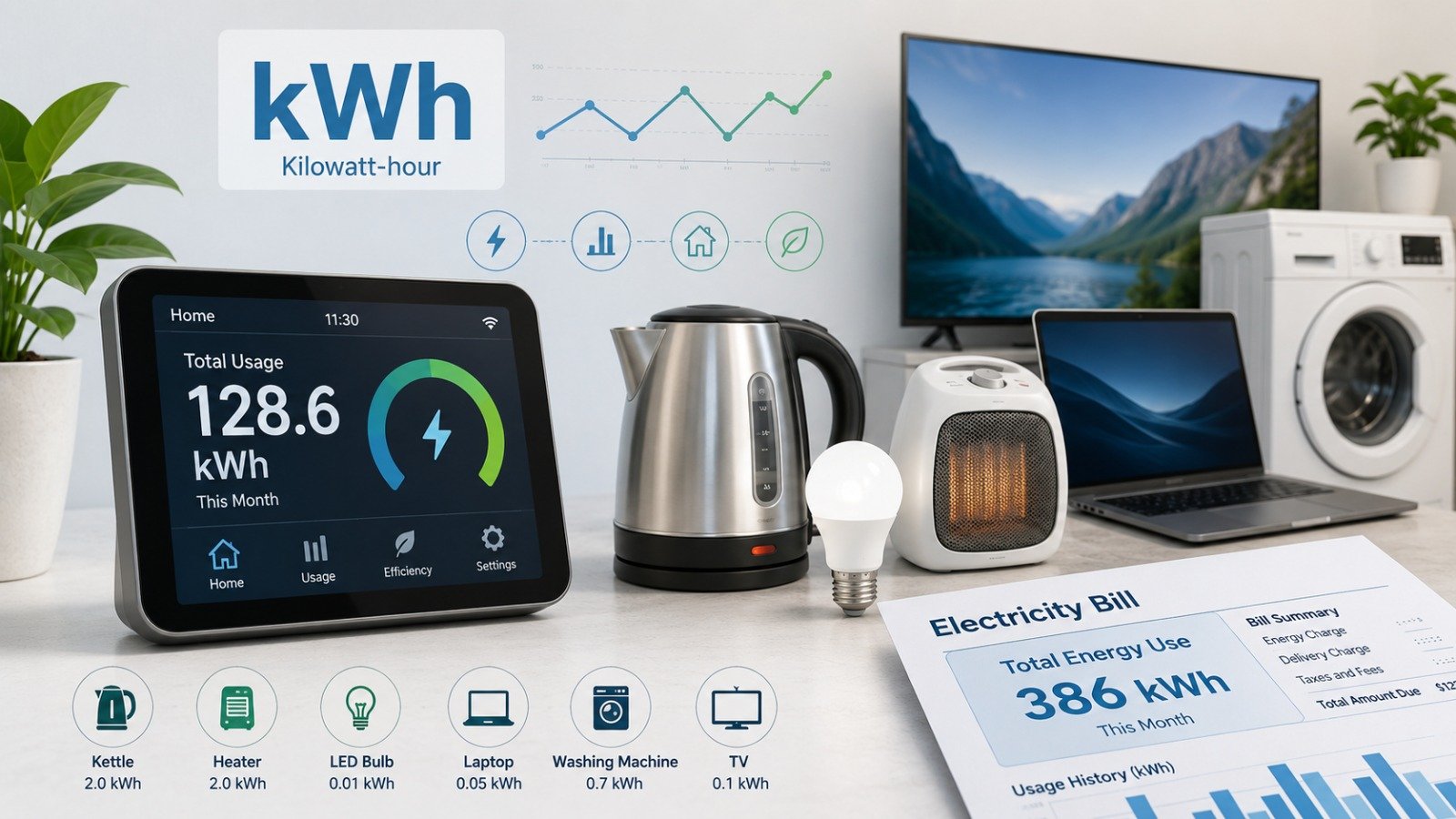
A kilowatt-hour, or kWh, is the unit used to measure electricity consumption on your bill. It shows how much electricity your appliances use over time. Understanding kWh helps you calculate appliance running costs, read your electricity bill clearly, compare unit rates, and find simple ways to reduce unnecessary electricity usage at home.
What Does kWh Mean?
The term kWh stands for kilowatt-hour. It is used to measure electricity consumption. A kilowatt means 1,000 watts, and an hour is the time the appliance is running. So, when both are joined together, kWh tells you how much electricity has been used during that time.
For example: if you use a 1 kW electric heater for 1 hour, it uses 1 kWh. If you use the same heater for 3 hours, it uses 3 kWh. If you use a 2 kW appliance for 1 hour, it uses 2 kWh.
This makes kWh useful because it does not only look at how powerful an appliance is. It also looks at how long you use it. A high-power appliance used for a short time may use less electricity than a low-power appliance running all day.
How to Read kWh on Your Electricity Bill
Your electricity bill usually shows how many kWh you used during the billing period. To understand it properly, check these parts:
- Electricity used: This shows your total kWh consumption.
- Unit rate: This shows how much you pay for each kWh.
- Standing charge: This is the daily fixed charge.
- Meter reading: This may be actual, smart, or estimated.
- Billing period: This shows how many days the bill covers.
If your bill is estimated, your kWh use may not be fully accurate. An estimated bill is based on predicted usage, not always your real meter reading. If your bill looks too high, compare it with your meter reading and check whether the supplier used an actual or estimated reading.
How to Calculate kWh
Calculating kWh is simple. You need to know the appliance power and how long you use it.
Formula:
kW × hours = kWh
If the appliance power is shown in watts, divide it by 1,000 first.
Watts ÷ 1,000 = kW
Example 1:
A 500W device runs for 4 hours.
500 ÷ 1,000 = 0.5 kW
0.5 × 4 = 2 kWh
So, the device uses 2 kWh of electricity.
This simple calculation helps you understand which appliances are increasing your electricity usage.
kW vs kWh: The Simple Difference
kW shows how powerful an appliance is, while kWh shows how much electricity it uses over time. In simple words, kW is the appliance’s power, and kWh is the total electricity used after it runs.
Term | Meaning | Simple Example |
| kW | Power of an appliance | A 2 kW heater is more powerful than a 1 kW heater |
| kWh | Electricity used over time | A 2 kW heater used for 1 hour uses 2 kWh |
So, if you want to understand your electricity cost, you need to look at kWh, not just kW. A 3 kW kettle may sound expensive, but it usually runs for only a few minutes. A fridge may use much less power at one time, but it runs all day, so its total usage can still be important.
How Much Does 1 kWh of Electricity Cost in the UK?
The cost of 1 kWh depends on your supplier, region, payment method, meter type, and tariff. People on fixed tariffs may pay a different amount from people on standard variable tariffs. Multi-rate users may also pay different prices at different times of the day.
For UK homes paying by Direct Debit on a standard variable tariff, the average electricity price cap unit rate is 24.67p per kWh from 1 April to 30 June 2026. From 1 July to 30 September 2026, it changes to 26.11p per kWh.
These are average figures, not a fixed price for every home. Your actual unit rate can be different depending on your area and supplier. This is why it is always important to check your latest bill before estimating your electricity costs.
What Can 1 kWh of Electricity Power? Common Appliance Usage Explained
One kWh can power different appliances for different amounts of time. It depends on the appliance’s wattage, energy efficiency, and how long it runs. Low-power appliances can run for many hours on 1 kWh, while heating appliances usually use electricity much faster.
| Appliance | Approximate Power | What 1 kWh Can Do / Estimated Usage |
LED bulb | 10W | Around 100 hours |
LED TV | 50W | Around 20 hours |
| Laptop | 50W–100W | Around 10–20 hours |
Microwave | 1,000W | Around 1 hour |
Electric heater | 1,000W | Around 1 hour |
| Oven | 2,000W | Around 30 minutes |
Washing machine | Per cycle | 0.5–2 kWh |
Dishwasher | Per cycle | 1–2 kWh |
Tumble dryer | Per cycle | 2–5 kWh |
Fridge freezer | Per day | 0.5–2 kWh |
TV | Per hour | 0.05–0.2 kWh |
Laptop | Per hour | 0.03–0.1 kWh |
This shows why heating and drying appliances often use more electricity. Kettles, ovens, tumble dryers, heaters, and washing machines can all add noticeable usage to your bill, especially when used often. A tumble dryer may use more electricity in one cycle than a laptop uses in many hours. This is why both wattage and running time matter when understanding kWh usage.
Why Your Electricity Usage May Be High
High usage can happen for many reasons. You may be using more appliances, working from home, using electric heating, charging more devices, cooking more often, or running older appliances that are less efficient.
Sometimes the problem is not real usage but billing. If your supplier uses estimated readings, your bill may be higher than expected. A tariff change can also make your bill rise even if your kWh use stays the same.
Common reasons for high electricity use include:
- Long electric heater use
- Frequent tumble dryer cycles
- Old fridge freezer
- Leaving appliances on standby
- More people living at home
- Working from home
- Electric cooking
- Poor appliance efficiency
- Estimated meter readings
- Higher unit rate
Checking your bill, meter reading, and appliance habits can help you find the main reason.
How to Reduce kWh Usage at Home
Reducing electricity kWh does not always mean changing your lifestyle completely. Small habits can make a clear difference over time.
Start by switching off appliances that are not being used. Avoid leaving TVs, games consoles, chargers, and computers on standby for long periods. Use the washing machine only when you have a full load and choose lower temperature settings when suitable.
Try to reduce tumble dryer use where possible. Drying clothes naturally can save a lot of electricity. Do not overfill the kettle; only boil the water you need. Replace old bulbs with LED bulbs, because they use much less electricity than traditional lighting.
If you use electric heating, control the time carefully. Electric heaters can use a lot of kWh quickly. A 2 kW heater running for 5 hours can use 10 kWh in one day. At a rate of 26p per kWh, that would cost around £2.60 for usage alone.
A smart meter can also help you track electricity use. It shows when your home uses more electricity and can help you spot expensive habits.
Simple Ways to Estimate Appliance Cost in par KW
To estimate the cost of an appliance, use this formula:
Appliance kWh × electricity unit rate = running cost
Example:
A tumble dryer uses 3 kWh per cycle.
Your electricity rate is 26p per kWh.
3 × 26p = 78p
So, one cycle costs about 78p in electricity usage.
If you use it 4 times per week:
78p × 4 = £3.12 per week
Over a month, this can become a noticeable cost. This is why appliance habits matter. One small change, such as reducing tumble dryer use, can lower your monthly electricity bill.
kWh and Standing Charge Are Different
Your kWh use is not the only part of the bill. The standing charge is a daily fixed cost you pay for being connected to the electricity network. You pay it even if you use little or no electricity that day.
This means your bill has two main parts:
- Usage cost: based on kWh used
- Standing charge: daily fixed charge
For example, if your standing charge is about 57p per day, it can add around £17 per month before your electricity usage is even counted. This is why reducing kWh can lower the usage part of the bill, but it will not remove the standing charge.
Final Thoughts
A kilowatt-hour may sound technical, but the idea is simple. It measures how much electricity you use over time. Your electricity bill uses this number to calculate your usage cost.
Once you understand kWh, you can see why some appliances cost more to run than others. You can also check whether your bill is based on real readings, compare your unit rate, and find ways to reduce electricity waste.
The best approach is to focus on the appliances that use the most electricity, especially heating, drying, washing, cooking, cooling, and devices that run for long hours. Small changes in these areas can help you control your electricity usage and make your bill easier to understand.
For more detailed guides and the latest updates, explore our Energy Guide.