Half-Hourly Meters in the UK: Complete Guide for Businesses
Half-Hourly Meters in the UK: A Complete Business Guide helps businesses understand how energy is measured, managed, and optimized in today’s competitive market. With rising electricity costs and stricter regulations, many UK businesses are turning to half-hourly metering for more accurate billing and better control over their energy usage.
This guide explains how these meters work, who needs them, and how they can help reduce costs while improving efficiency.
Table of Contents
What is a Half-Hourly Meter?
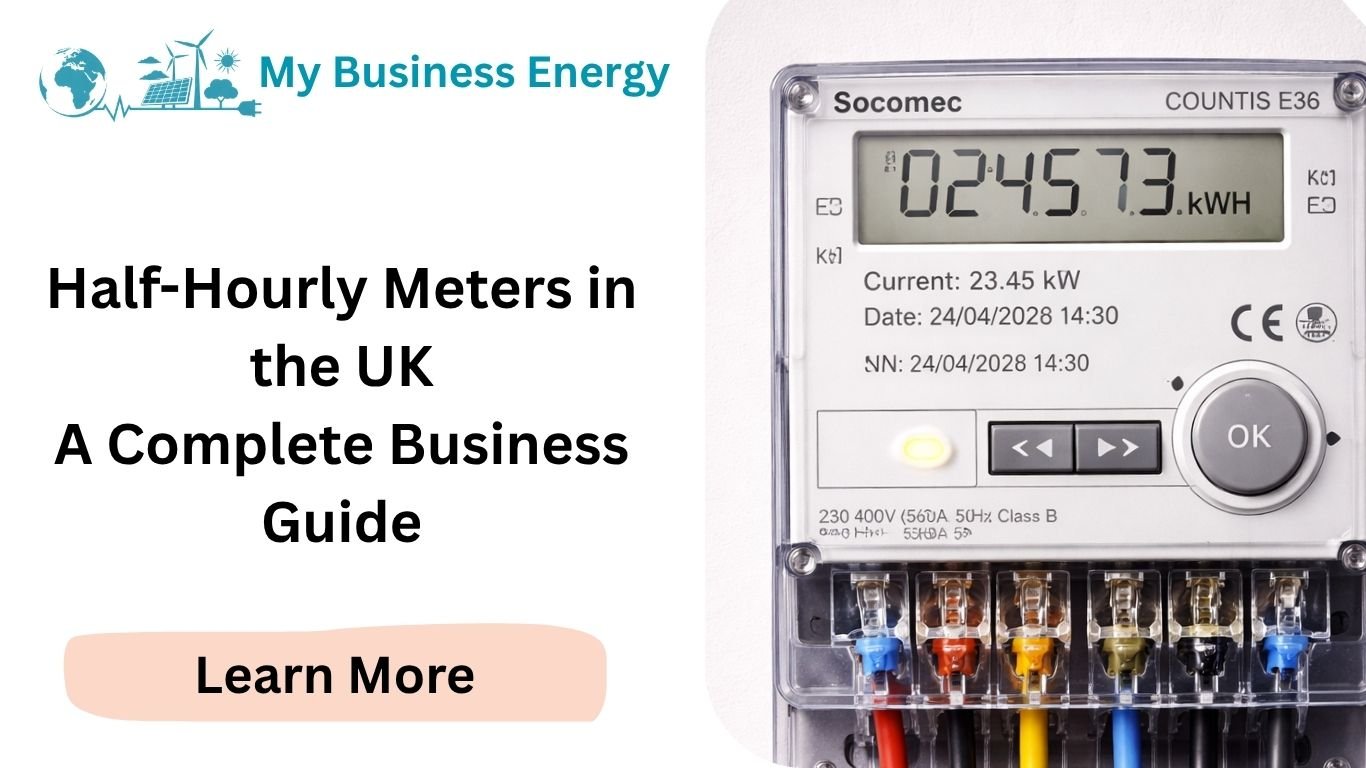
A half-hourly (HH) metre is an electricity metre that automatically records your business’s electricity usage in 30-minute intervals—48 readings per day. These readings are transmitted directly to your supplier, eliminating the need for manual meter reads.
Half-hourly meters are primarily used by commercial and industrial businesses with higher electricity demands. They bring out a much more complete and detailed picture of electricity use than regular meters, which only track the aggregate amount used for the whole of the billing period.
In the United Kingdom, half hourly meters are identified through a Meter Point Administration Number (MPAN), where the starting digits are the profile class code ’00’. If your MPAN starts with 00, your site is already registered as a half-hourly supply point.
How Does a Half-Hourly Meter Work?
The meter records electricity consumption every 30 minutes and sends that data electronically to a Data Collector (DC) and Data Aggregator (DA), two roles within the UK’s electricity deal system. These parties process your consumption data and pass it to your energy supplier, who uses it to calculate your bills.
Because the data flows automatically, billing is always based on actual consumption rather than estimates. This removes a common source of billing disputes and makes it easier to spot anomalies or unexpected peaks in usage.
Time-Interval Meters are included in the national grid payment system, so your power charges can change depending on the time of day when your business consumes electricity. Peak hours usually have more expensive wholesale rates; thus, being aware of your consumption pattern could influence your expenses.
How to Read a Half-Hourly Meter
Unlike traditional meters, you do not typically need to read a half-hour meter yourself. Data is collected automatically through a communication module attached to the meter.
- However, your meter will still display consumption data on its screen. To manually verify readings:
- Press the display button on the meter until you see the kWh (kilowatt-hour) reading.
- Note the figures before the decimal point—these represent the units consumed.
- Compare readings across intervals if you want to monitor usage manually.
Most businesses access their half-hourly data through an online portal provided by their energy supplier or a third-party energy management platform. These platforms visually represent your 48 daily readings, facilitating the identification of trends.
Benefits of a Half-Hourly Meter
- Accurate billing: Every bill reflects what you actually used—no estimates, no corrections at the end of the year.
- Detailed consumption data: With 48 data points per day, you can see exactly when your business consumes the most electricity and where inefficiencies exist.
- Time-of-use tariffs: Numerous suppliers provide half-hourly tariffs that adjust electricity prices based on usage time. Shift energy-intensive activities to off-peak periods and your bills can drop significantly.
- Better energy management: Half-hourly data, which refers to electricity usage data collected every half hour, integrates with energy monitoring software, making it easier to track KPIs (key performance indicators), set targets, and report on sustainability initiatives.
Disadvantages of a Half-Hourly Meter
Half-hourly metering is not without its balances.
- Higher standing charges: Half-hourly supply points often carry higher standing charges than non-half-hourly sites due to the additional system and data management involved.
- Complexity: Half-hourly tariffs can be harder to compare and understand than simple unit-rate contracts. You may need a broker or energy consultant to navigate the market.
- Data management: Having access to large volumes of usage data is only useful if you have the tools and time to act on it. Without proper analysis, the data remain unused.
- Not always cost-effective for smaller users: If your business has a low or stable energy demand, the additional costs associated with half-hourly metering may exceed the benefits.
Half-Hourly Meter vs Non-Half-Hourly Meter
The core difference comes down to how data is recorded and billed.
Feature | Half-Hourly Meter | Non-Half-Hourly Meter |
Data intervals | Every 30 minutes | Periodic/estimated |
Data transmission | Automatic | Manual or estimated |
Billing accuracy | High | Lower |
Tariff options | Time-of-use tariffs | Standard fixed tariffs |
Suitable for | High-demand businesses | Low-demand businesses |
Non-half-hourly meters work by Categorising businesses into general consumption profiles. So, part of your bill is actually based on assumed usage patterns rather than your true behavior, which can lead to mistakes in billing and may not reflect your actual electricity usage. On the other hand, Time-Interval Meters completely do away with this idea, providing a more accurate measurement of electricity usage by recording usage in real-time.
How Much Does a Half-Hourly Meter Cost?
Costs vary depending on your supplier, meter type, and site requirements. Generally, you can expect:
- Meter installation: £200–£800, depending on complexity
- Data Collection and Aggregation (DCA) charges: Typically £100–£300 per year, though these are often bundled into your energy contract.
- Standing charges: These tend to be higher for HH supply points, reflecting the additional services involved.
Some suppliers incorporate the DCA charges into their unit rate. So, it is necessary to check and compare the contracts carefully. If you use an energy broker, it will be easier for you to spot the most affordable deal that fits your usage profile.
How to Check If You Have a Half-Hourly Meter
The first thing to check is to look at your electricity bill or contract. Find your MPAN (Meter Point Administration Number)—a 21-digit number usually found in the top-left corner of your bill. If the first two digits are 00, your site is a required half-hourly supply point.
If your MPAN starts with 05, 06, 07, or 08, your site may have been migrated to half-hourly settlement under the P272 regulations. Contact your supplier to confirm your current metering setup.
You may also inspect the meter itself. Half hourly meters are frequently provided with a communication module (Meter Communication Unit), and the meter display will normally indicate interval data instead of just showing a total reading.
Who Needs a Half-Hourly Meter in the UK?
In the UK, mandatory half-hourly settlement applies to businesses with a peak demand exceeding 100 kW (profile classes 00, 05–08). These sites are legally required to have a half-hour meter installed.
Businesses that fall into profile classes 05–08—which typically have a maximum demand between 25 kW and 100 kW—may be required to migrate to half-hourly settlement under Ofgem’s P272 mandate, which came into effect in April 2017.
Even if your business is not legally required to have one, you can opt into half-hourly metering voluntarily. Many SMEs with moderate energy demands do so to gain better visibility of their usage and access more competitive tariffs.
How to Get a Half-Hourly Meter Installed
Getting a half-hourly meter installed is a straightforward process:
- Contact your energy supplier: Let them know you want to move to half-hourly metering. They’ll arrange a site survey to assess your current setup.
- Choose a meter operator: Your supplier will recommend an approved Meter Operator (MOP) to install and maintain the meter.
- Schedule installation: A qualified engineer will install the meter, typically during business hours. Depending on your current setup, installation can take a few hours.
- Register the meter: Your supplier will register your MPAN as a half-hourly supply point with the relevant Data Collector and Aggregator.
- Set up data access: Ask your supplier or a third-party platform to give you access to your consumption data.
The process usually takes two to six weeks from initial request to the meter going live.
Half-Hourly Meter vs Smart Meter
These two metre types are often confused, but they serve different purposes.
- Smart meters are primarily designed for residential and small business use. They record consumption in shorter intervals (typically every 30 minutes or hourly) and send data to your supplier automatically, but they operate on a different communication network (the DCC—Data Communications Company).
- Half-hourly meters operate within the larger commercial electricity settlement framework, use dedicated communication infrastructure, and are designed for high-demand commercial sites.
That said, the distinction is narrowing. The rollout of smart meters for businesses under the government’s national smart meter program is bringing similar functionality to smaller commercial sites, but for medium- and large businesses, half-hourly meters remain the standard.
How Time-Interval Meters Help Reduce Energy Bills
The link between half-hourly data and lower bills is direct. Here’s how it plays out in practice:
- Demand management: Half-hourly tariffs often include a Triad charge—a levy based on your consumption during the three peak demand periods in winter (typically 4pm–7pm on weekday evenings). If you can reduce usage during these windows, the savings can be substantial.
- Shifting loads: Being aware of your accurate usage profile gives you the ability to reschedule heavy energy consumption activities – for example, manufacturing runs or HVAC systems – to off-peak periods when unit rates are low.
- Identifying waste: A sudden spike in your 3am data point suggests equipment that should be off is still running. Without half-hourly data, that kind of waste often goes unnoticed for months.
- Negotiating better contracts: suppliers look more favourably at businesses that can demonstrate predictable, manageable consumption profiles. Half-hourly data gives you the evidence to support better commercial terms.
How to Switch Your Half-Hourly Electricity Tariff
Switching tariffs as a half-hourly customer follows the same broad process as any business energy switch:
- Review your current contract: Remember your end date and any termination clauses. Most business energy contracts require 30—90 days’ notice.
- Gather your consumption data: Your half-hourly data should be accessible from your existing supplier or through your online portal. Share this information with the potential new suppliers to get accurate quotes.
- Compare suppliers: You should work with an energy broker or comparison service specialising in commercial half-hourly contracts. Most general comparison tools do not accommodate HH supply points.
- Negotiate: Half-hourly customers typically have more leverage when switching, given the detailed consumption data available.
- Confirm the transfer: Your new supplier will handle the transfer of your MPAN and arrange for DCA services to be updated.
You can’t switch mid-contract without paying exit fees. So think a little further ahead and start the procedure around three months before your renewal date.
Final Thought
A half-hourly meter is a practical tool for any business serious about controlling energy costs. The data it provides isn’t just useful for billing—it’s the foundation for smarter procurement, better demand management, and meaningful progress toward energy efficiency targets.
If your business is approaching the 100 kW demand threshold, or if you’ve been operating on estimated billing for too long, now is a good time to explore your options. Speak to your supplier or an independent energy consultant to find out whether half-hourly metering makes commercial sense for your site.
If you learn About Business Electricity Guide Please Visit Our Website.
Frequently Asked Questions
Got questions about half-hourly meters? Here are simple answers to the most common things businesses want to know.
Q1: Do I legally need a half-hourly meter?
If your business has a peak demand exceeding 100 kW (MPAN profile class 00), half-hourly metering is mandatory. Businesses in profile classes 05–08 may also be required to settle on a half-hourly basis under the P272 regulations.
Q2: Can small businesses get a half-hourly meter?
Yes. While it isn’t always mandatory for smaller businesses, any commercial customer can opt into half-hourly metering voluntarily. Whether it’s cost-effective depends on your energy demand and usage patterns.
Q3: Can a half-hourly meter help businesses budget better?
Yes. A half-hourly meter can help businesses budget better by showing exact energy use every 30 minutes, so bills are more accurate and costs are easier to predict.
Q4: Can a half-hourly meter show peak electricity usage?
Yes, it can show the times when your business uses the most electricity. This is useful for finding busy periods and reducing costs during peak demand hours.
Q5: Do half-hourly meters require manual readings?
Usually, no. Most half-hourly meters send readings automatically, which saves time and reduces the chance of estimated bills.